
I started seeing ads for Etat Libre d’Orange, a French perfume house, sometime last year. Before I left Facebook, it seemed like I was seeing at least one ad every time I scrolled. The ads worked because I got lured into buying a decant of You or Someone Like You from in the early days of my hyperfixation on fragrance. In part it was the notes—I’ve been into green/fresh scents—but it was also the proximity to the title of the Matchbox 20 album Yourself or Someone Like You, which I listened to about everyday in eighth grade.1
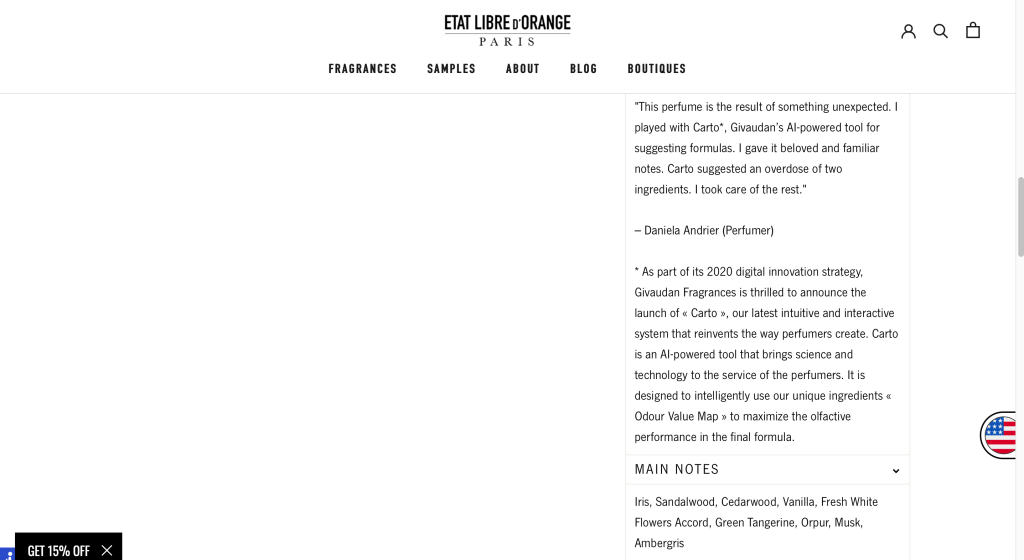
When I tried it, I fell in love. There’s this initial mojito-like blast in the opening that fades into an old-lady-ish rose. I hadn’t smelled anything like it before and wanted a full bottle. The price on the regular website, $110 for 50mL/$170 for 100mL, was a bit more than I wanted to pay2, so I started searching for bargains. I’d seen it mentioned on Reddit that TJ Maxx sometimes gets ELDO at a discount.3 I didn’t find You or Someone Like You. I did, however, find another perfume of theirs: Story of Your Life. You may see a trend here, but the name of the perfume reminded me of Ted Chiang’s novella4, so that caught my attention. A scan of Parfumo revealed a brioche note—who wouldn’t want to smell like brioche? But the copy on the ELDO website drew me up short:
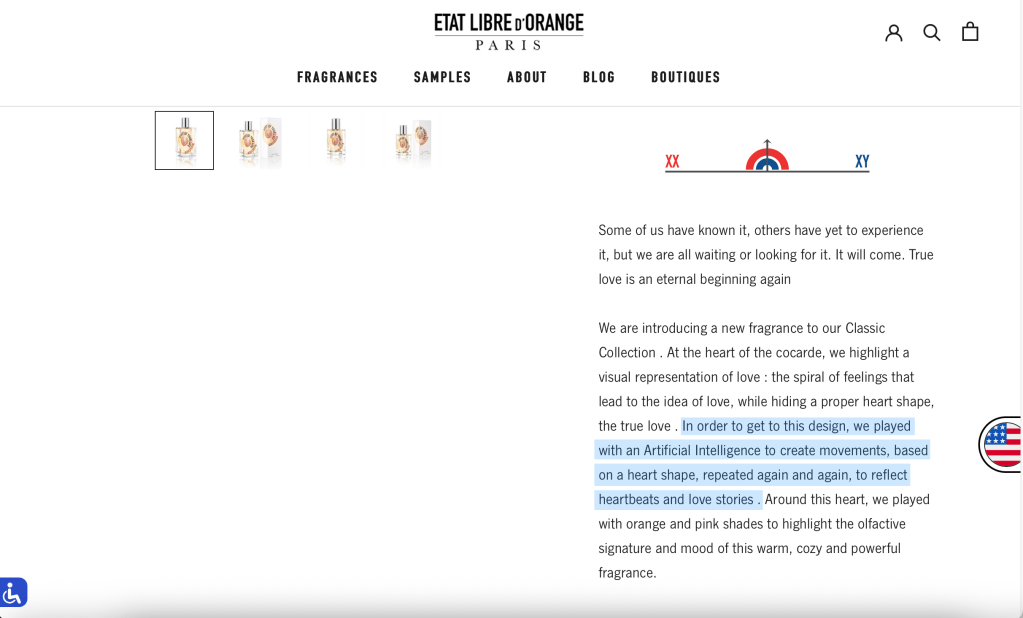
The more I learn about generative AI, the more I am against expanding its use beyond limited practical applications in medicine and other sciences. When I see no justification for a company’s use of AI, I see no justification in them getting my money, particularly for a luxury product like perfume. I am admittedly biased, having briefly worked for a generative AI company before becoming a writing instructor, but the environmental and labor issues5 involved should be a concern to anyone. Taking a closer look at the cocarde, where ELDO “played with” an AI, there’s nothing about the design that’s particularly revelatory or interesting.
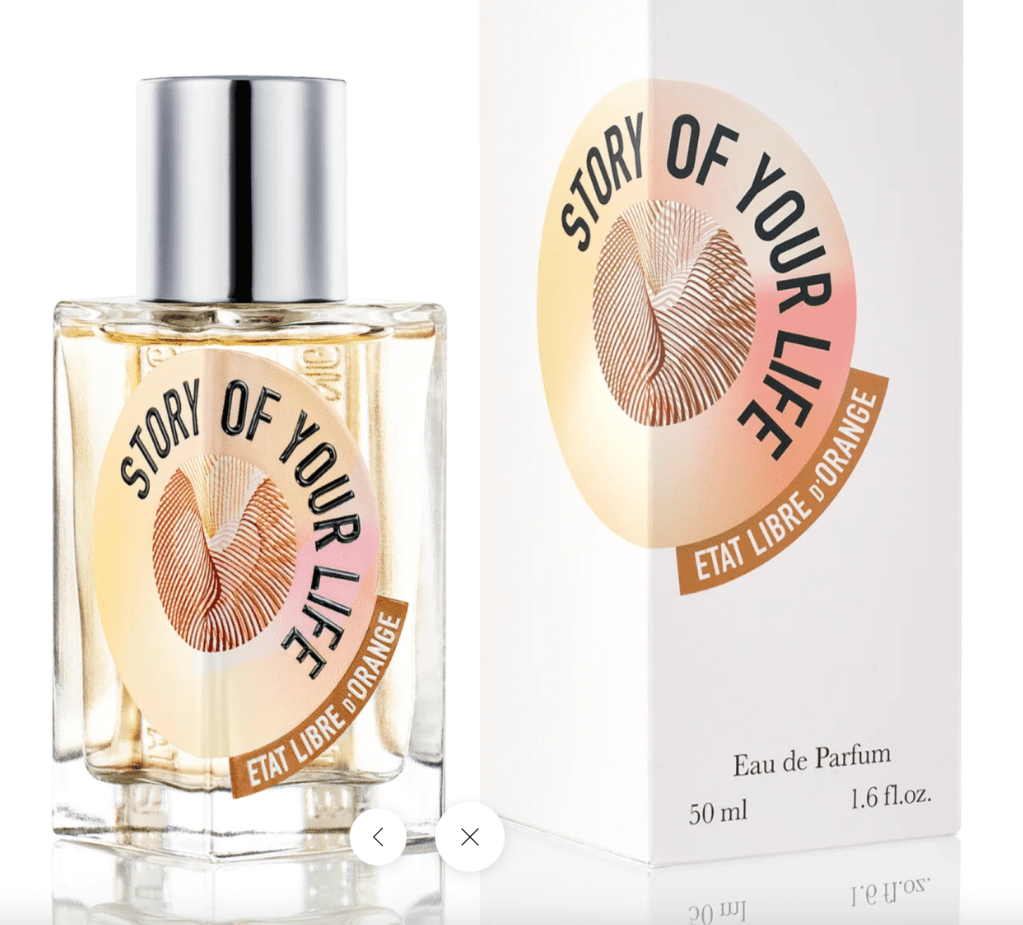
It looks like a smudgy thumbprint.

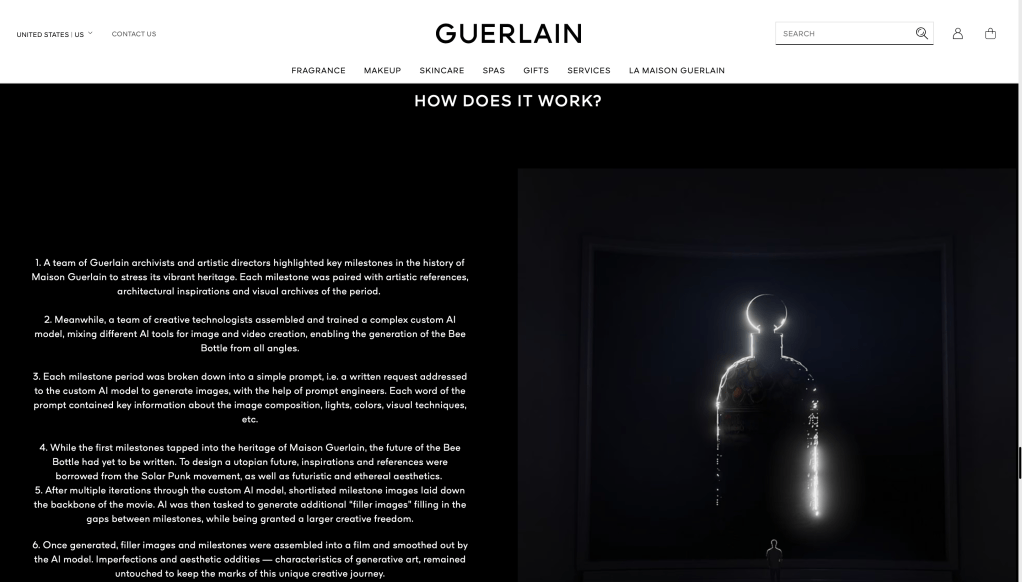
While looking for a substitute for You or Someone Like You, since I won’t be buying from ELDO, I saw Guerlain’s Aqua Allegoria Rosa Verde or Herba Fresca have some similarities in green notes. But in perusing the website, repeated phrases like “a powerful symbol” and “an invitation” triggered my spidey senses, and it didn’t take long to find out how they are embracing AI as well. Known for their iconic bee bottle, which was first created for Empress Eugenie, Guerlain used AI to reimagine the bottle in its various iterations from 1853 to 2193. They created a video but the explanations of their reasoning and process are more interesting because, frankly, the “art” looks like shit.
The composition of perfumes is both art and science. A nose undergoes many years of training in order to work for major houses, sometimes completing advanced studies in chemistry prior to perfumery school. It seems akin to artists working as apprentices under a master to learn their craft, requiring perhaps some innate skill in sense of smell but more importantly—hard work. I would assume that fellow artists would respect human labor and creativity in other fields and avoid generative AI. And yet, beyond just using it as a sloppy shortcut for design to promote their products, some perfumers have embraced AI in the creation of perfumes. Renowned perfumery school Givaudan touts its program Carto’s ability to create instant samples using “the best possible formula” and says the program “makes the process more efficient and enjoyable.” Carto and similar programs pose an opportunity to reduce material waste and labor hours and, in the best of all possible worlds, would make life easier for the worker. I doubt it will be used that way. Gareth Watkins, writing on the links between AI and fascism, has pointed out:
That even the best AI models are not fit to be used in any professional context is largely irrelevant. The selling point is that their users don’t have to pay (and, more importantly, interact with) a person who is felt to be beneath them, but upon whose technical skills they’d be forced to depend…For its right wing adherents, the absence of humans is a feature, not a bug, of AI art.
Once the noses have trained these programs to be “good enough” companies will look for ways to pay workers less or replace them altogether. The potential expendability of labor is why so many companies have bet big on a technology that many consumers simply do not want.
Carto was used to create ELDO’s She Was an Anomaly in 2019, and the description from their website emphasizes how the company positions itself as an outsider—there is an ironic element here, as it suggests, but the company itself does not seem to understand where the irony originates:
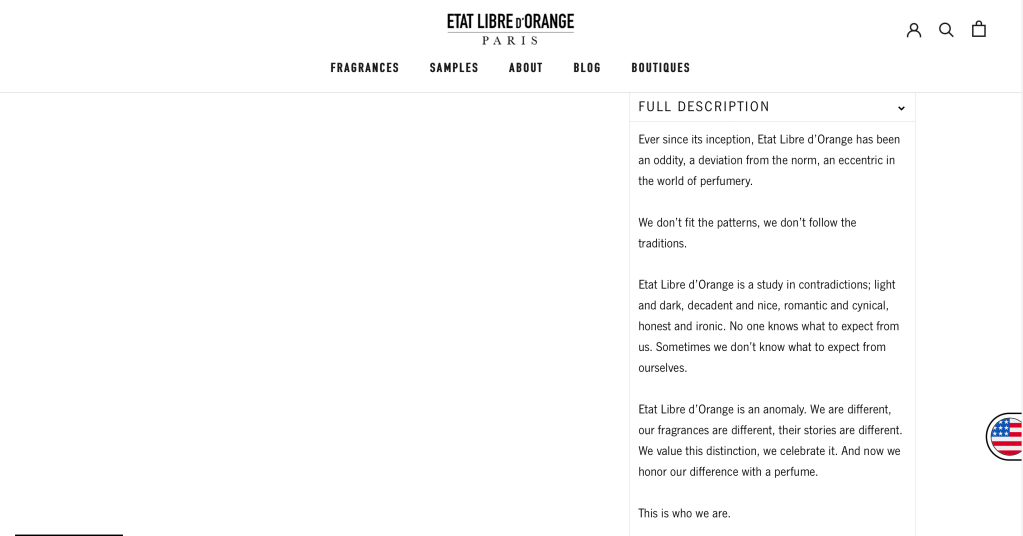
These self-described eccentrics and deviants share DNA with other industry disruptors. Etienne de Swardt’s South African origins and obsession with being seen as an edgelord naturally call to mind Elon Musk. Etat Libre d’Orange, or the Orange Free State, was an independent Boer republic that ceased to exist following the end of the Second Boer War in 1902. De Swardt chose to honor his birthplace when naming the company, describing it as “a land of staggeringly rough beauty and color and unforgettable smells, a nation of contrasts, strong feelings, and mixed emotions. A rainbow mosaic of people and cultures and it was independent.” Now, I have just a soupçon of knowledge of South African history, but I think anyone passingly familiar with the horrors of colonialism and apartheid might question the romantic image he creates.
Following the end of the Orange Free State, the newly-formed Union of South Africa enacted one of its first major segregation laws in 1913. The Native Lands Act mostly banned the sale or lease of land to Black people outside of limited reservations, helping pave the way for later apartheid laws. Sol Plaatje, an African writer and politician born in the Orange Free State—who later was a founding member of the African National Congress—wrote Native Life in South Africa in 1916 as response to the law and highlighted how the act was inspired by extant codes in Orange Free State:
In this connexion, the realization of the prophecy of an old Basuto became increasingly believable to us. It was to this effect, namely: “That the Imperial Government, after conquering the Boers, handed back to them their old Republics…That the Boers…will make a law declaring it a crime for a Native to live in South Africa, unless he is a servant in the employ of a Boer, and that from this it will be just one step to complete slavery.” This is being realized, for to-day we have, extended throughout the Union of South Africa, a “Free” State law which makes it illegal for Natives to live on farms except as servants in the employ of Europeans…He can only live in town as a servant in the employ of a European. And if the followers of General Hertzog are permitted to dragoon the Union Government into enforcing “Free” State ideals against the Natives of the Union, as they have successfully done under the Natives’ Land Act, it will only be a matter of time before we have a Natives’ Urban Act enforced throughout South Africa. Then we will have the banner of slavery fully unfurled (of course, under another name) throughout the length and breadth of the land.
Following the enactment of the legislation, white farmers began to expel Black farmers from their land and police in the former Orange Free State militantly enforced pass laws to regulate movement, employment, and residency. Obtaining a pass cost money that many Black people could not afford, particularly once their property was seized, but those found without passes were subject to violence, fines, and imprisonment. As de Swardt said in an interview with Fragrantica6, “The Boers wanted to reinvent rules their own way.”
Positioning himself and his company as outsiders is also interesting given de Swardt’s background as an executive for LVMH, a conglomerate that specializes in luxury goods. He did for their companies what he does for ELDO: he provides ideas for perfumes and marketing and has other people create them, as he is not a nose. His first independent venture was a perfume for dogs, an idea which raised $12 million but was “ahead of its time” and not much of a success. De Swardt launched ELDO in 2006. Among the first fragrance releases was Secretions Magnifiques, created by Antoine Lie, which has accords of blood, sweat, semen, and saliva. I appreciate an avant-garde approach and pushing the boundaries of what we think fragrance can be. But other details, like choosing 69 Rue des Archives as the address for their flagship boutique, or having perfumes called “Philippine Houseboy” and “Don’t Get Me Wrong Baby, I Don’t Swallow,” suggests that ELDO is not so much avant-garde as puerile.7 While they do demonstrate more restraint in their deployment of AI than Guerlain’s slop, ELDO’s use of the technology is a handy red flag for a consumer wanting to avoid creeping fascism.
- I hadn’t heard of the book it’s actually named after. You or Someone Like You is by Chandler Burr, who is more known for his perfume criticism than his fiction. His book The Perfect Scent: A Year Inside the Perfume Industry in Paris and New York is on my TBR though because it follows the creation of Un Jardin sur le Nil by Hermès. ↩︎
- This is not the most fiscally responsible hobby I could have chosen. ↩︎
- For those also looking for bargains, the chain sometimes gets DS & Durga and Vilhelm Parfumerie. Costco online is always worth checking, too. ↩︎
- I have better taste in books than in music. ↩︎
- On the subject, I’m looking forward to reading Karen Hao’s Empire of AI, which investigates these concerns in the context of OpenAI/ChatGPT. ↩︎
- I am not linking to Fragrantica because unpacking their batshit views is a whole other blog post. Use Parfumo to look up your notes. They’re more accurate anyway. ↩︎
- Since renamed “Le Fils de Dieu du Riz et des Agrumes” and “Yes I Do” respectively, so perhaps the appeal of being edgy has worn off in the face of investors. The scents themselves sound fairly conventional. ↩︎
 the main character of every grocery store
Leave a comment