
Following the assault on the U.S. Capitol on January 6th, one of the most indelible figures was Jake Angeli, the QAnon Shaman. While The Handmaid’s Tale and *gestures wildly at everything else* has been preparing me for a theocracy, I wasn’t quite expecting it to be Wotanist. After roaming the halls of Congress in face paint and furs and returning home to Arizona, Angeli has since been arrested and held on federal misdemeanor charges. He made the news once more after his public defender told the judge Angeli has not eaten since being taken into custody because he is on a restrictive diet consisting exclusively of organic foods.
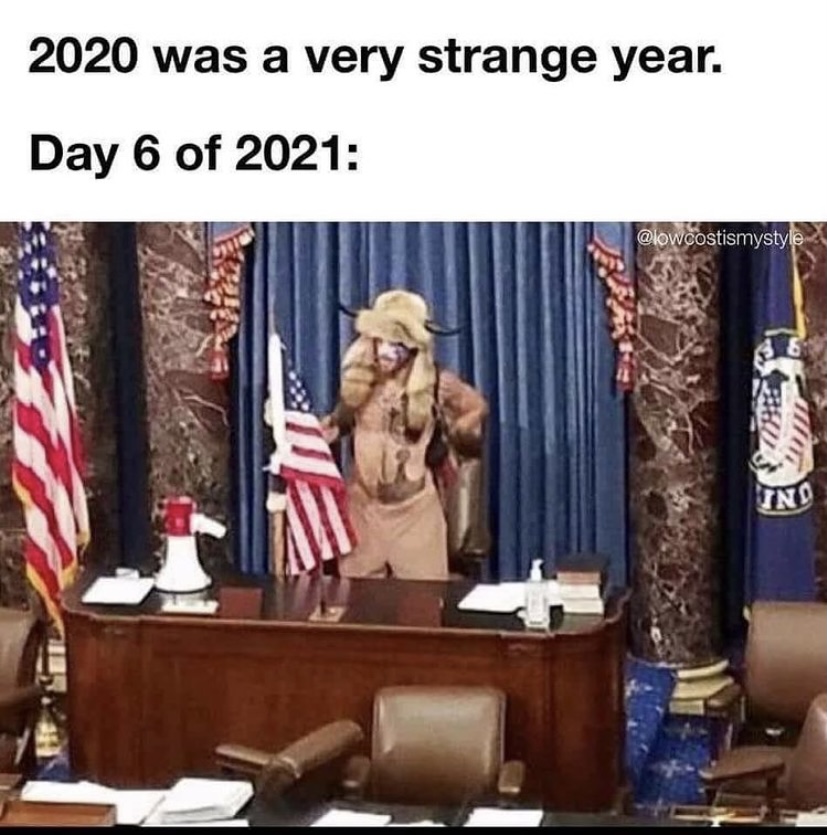
Angeli’s mother told reporters “he gets very sick if he doesn’t eat organic food – literally will get physically sick.” While the government has previously ignored dietary requests due to religious or health reasons, most notoriously feeding Muslim detainees pork, U.S. Marshals indicated that they would follow the judge’s order to provide Angeli with organic food. I’m no longer surprised at the special treatment white supremacists get from our government, but I was left wondering: what does a Q shaman eat?
What we talk about when we talk about Q shamans Angeli’s Q Shaman personality seems to stem from the Neoshamanism movement, a syncretic, culturally appropriative system. Michael Harner, who wrote The Way of the Shaman, promoted this “core shamanism” to white audiences as an umbrella for practices ranging from healing, making psychic journeys to other worlds, and interacting with spirits, lifting rituals from Indigenous peoples in the Americas, Siberia, and elsewhere. Frederick Kunkle, in The Washington Post, summarizes Angeli’s beliefs:
Chansley [Angeli’s legal name] said he had spent much of his life around Phoenix, following a spiritual path that led him from Catholicism to a mix of pagan and New Age-like religious beliefs. His shaman’s clothing reflected that, he said. The fur is that of a coyote, an animal that some Native American traditions have long regarded as a trickster.
‘That’s why I wear the skin…because you cannot pull the wool over the eyes of an Angeli,” he said.
He is also heavily tattooed with Nordic insignia that Rolling Stone reported as having been adopted by far-right white nationalists.
QAnon views are positioned as a glimpse beyond the veil, pulling the wool away from the eyes to reveal the secret war that Trump is fighting against Satan-worshipping, cannibalistic, pedophiles who hold positions of power in government, media, and business. Adherents look for cryptic messages in digital media and await an apocalyptic “Storm” when this cabal will be brought to justice. A Q Shaman, as such, could be said to deliver messages from this other world.
Curiously enough, the shamanism practiced on the steppes, from where the term originally derives, historically has its roots in resistance to colonialism. Chris Gosden in Magic: A History, writes:
For the groups we now see as the indigenous peoples of the grassland Steppe, forest and tundra, the last two millennia have witnessed incursions of a great variety of polities, who have taken land, extracted resources and pursued goals of their own, often through conquest and subjugation…Shamanism arose from a repurposing of earlier belief systems, which came into being around a politics of resistance to unified groups, such as the Uighurs, and it has developed in this vein ever since…Shamans were group spiritual trouble-shooters, tasked with attempting to resolve issues facing the group, which might manifest themselves in everyday reality, but always had a root in the spirit world. As the troubles of colonialism proliferated, so too did the shamans (181-2).
It adds an extra layer of absurdity (and disgust) then, seeing a man who has clearly benefited from white settler colonialism take on the mantle of shaman in his actions to oppress and disenfranchise others.
Those of us who have lost loved ones to the Q cult or Trumpism know that a lot of people genuinely believe these conspiracy theories, and I’m not going to debate the sincerity of Angeli’s beliefs here. Legally, in the United States, reasonable accommodations must be made for a person’s religious practices. So then, if it’s not just a ploy to perhaps get better food (though I don’t deny that may be part of it), what does Angeli’s request for organic food tell us about his beliefs?
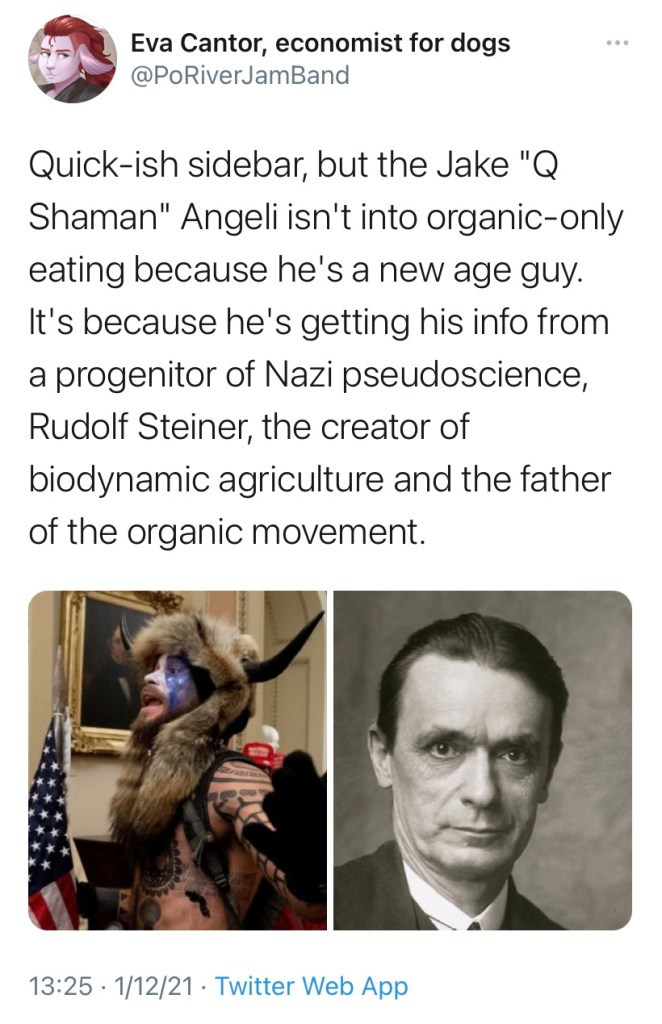
Nazis at the Farmers Market The organic food movement is often seen as elitist, led by cheerleaders like Michael Pollan and Alice Waters, criticized for advocating a diet few can afford which may not even lead to better health outcomes and which centers white culinary traditions. In recent years, former darlings of the movement like Joel Salatin and Baker Creek Heirloom Seeds have revealed that the libertarian streak among some organic farmers is in many cases built on a foundation of white supremacy. While folks like Anderson Cooper might portray the rioters at the Capitol as uncultured buffoons on their way to a celebratory dinner at the Olive Garden, white supremacy and organic agriculture have more links than one might think. Eva Cantor, an organizer and economist, pointed this out on Twitter in a thread that’s gone viral in food circles.
Before this, I’d only ever heard biodynamic used interchangeably with organic, occasionally noticing it on some labels at the grocery store. Taking a deeper dive, I found it has practices more associated with sympathetic magic than science, such as burying a cow horn full of manure or quartz or preparing teas with ingredients like horsetail or yarrow for the compost pile, as if treating soil with homeopathic medicine.
Now, I come from people who plant by the signs, so that doesn’t sound too incredibly strange. But Steiner’s thoughts on Atlantis and race evolution do more than complicate matters, as his modern Waldorf supporters would say, but rather provide more evidence that a fixation on clean eating and clean bodies more often than not is rooted in white supremacy and that sometimes environmentalism takes on an ecofascist bent.
When I briefly worked at a farmers market, there was a particular farm we always hoped to avoid being near. The farmers were unpleasant, often pushing away the merchandise tables of neighboring vendors if they felt they were too close and never greeting others. I didn’t think much of it until one morning, with no preamble, one of those farmers asked my coworker, “are you a Jew?” She chose to ignore him and went about her day, but we found out later that such interactions with them weren’t that uncommon. Apparently they’re not uncommon at other farmers markets either. In 2019, in Indiana (Mike Pence’s home state), the Bloomington Community Farmers Market was briefly suspended when a vendor, Schooner Creek Farm, was revealed to have ties with a white supremacist group. Activists came to the market to stand in front of the stall and inform customers, which attracted the attention of an armed militia. The mayor closed the market for two weeks due to safety concerns, but later reopened. Schooner Creek was allowed to stay (as were the racists at my own farmers market), and some vendors and customers chose to leave due to the lack of response. On Schooner Creek’s website, responding to the protests and painting their racism as a First Amendment issue, they say, “We just want to be able to continue farming in peace and providing wholesome food to our community.” But if we’re reading between the lines, we can pick out some phrases that dog whistle:
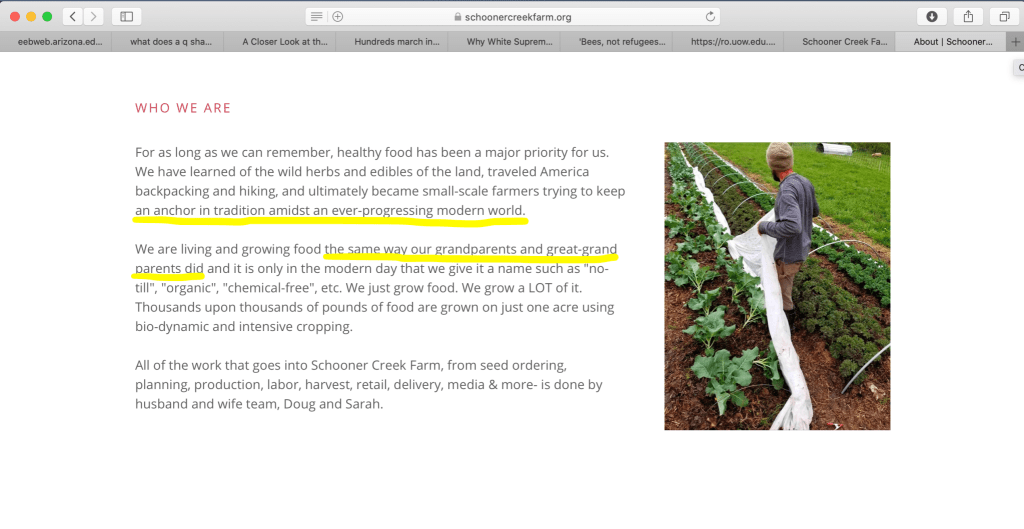
And then some that just whistle:
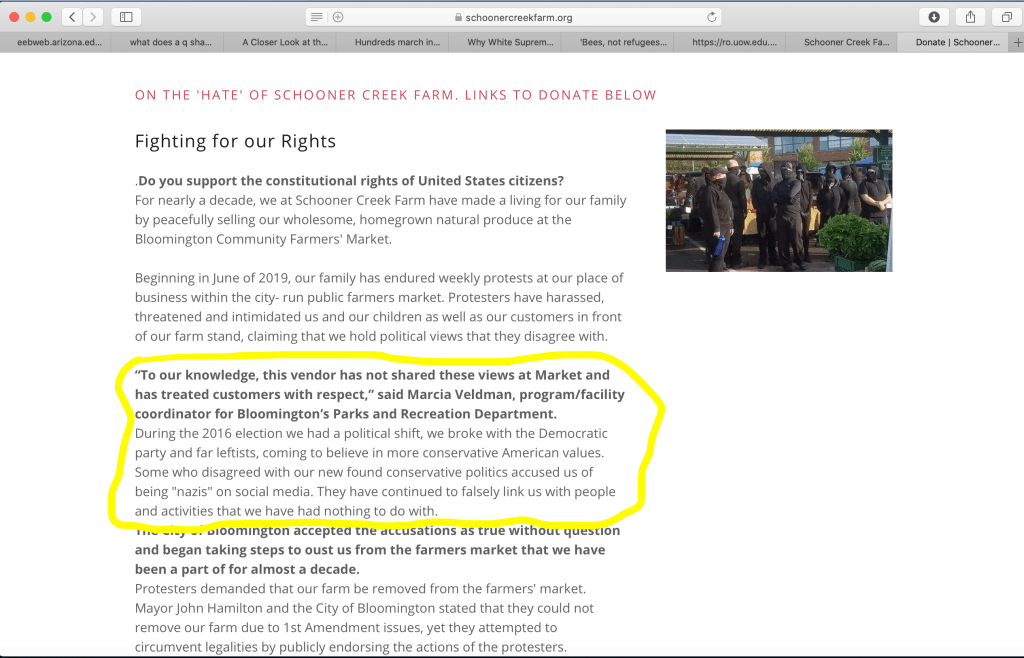
Far from enclaves for gentle hippies, farmers markets can be a comfortable gathering place for white supremacists seeking a return to their imagined Eden, who are well-accustomed to listening at different frequencies. What’s worse is that these individuals and farmers are protected, not just by armed militias, but also more perniciously by the unwillingness of other white people to fully reckon with racism in their communities and race-based discrimination from the USDA and banks that keep Black people and other people of color out of farming. While Angeli sounds a bit ridiculous in the Washington Post, saying “when you watch television, when you listen to the radio, there are very specific frequencies that are inaudible that actually affect the brain waves,” it’s not an unreasonable analogy for the impact centuries of white supremacy and our current media diet has on our consciousness.
Blood and soil, milk and soy If seeking portents for what’s happening currently, we can look back to the Unite the Right rally in Charlottesville in 2017. Watching footage of the white supremacist protesters there was the first time I (and I assume many others) had heard the phrase “Blood and Soil.” The use of this phrase is based in Nazi ideology, which praised rural farmers with long family ties to Germany and sought to instill a sense of national pride in these populations. Nazis mixed their metaphors in extending this, referring to Jews as both rootless and weeds. This ideology manifested in Lebensraum, where Germany sought to expand its territory into Central and Eastern Europe, allowing for more control over its food supply through farmland and thus preventing being starved out by British blockades.
The food ecology that Angeli comes from has had two prominent concerns emerge in the past couple of years: milk and soy. While the rhetoric surrounding them occupies opposite ends of the spectrum, with one a source of praise and another an insult, at the core of these messages is the same concern over pure land and bodies.
In 2017, Richard Spencer, the neo-Nazi with an eminently punchable face who coined the term “alt-right”, put a milk emoji in his Twitter handle. The majority of adults worldwide (about 65%) cannot properly digest milk. The highest rates of lactase persistence are in northern Europe and Scandinavia. White supremacists seeking evidence of their superiority seized on this fact, and have flooded social media with images of tall glasses or gallons of milk, bragging about their ability to consume it in comfort. For them, I’m sure it’s a delightful coincidence that their beverage of choice is white.

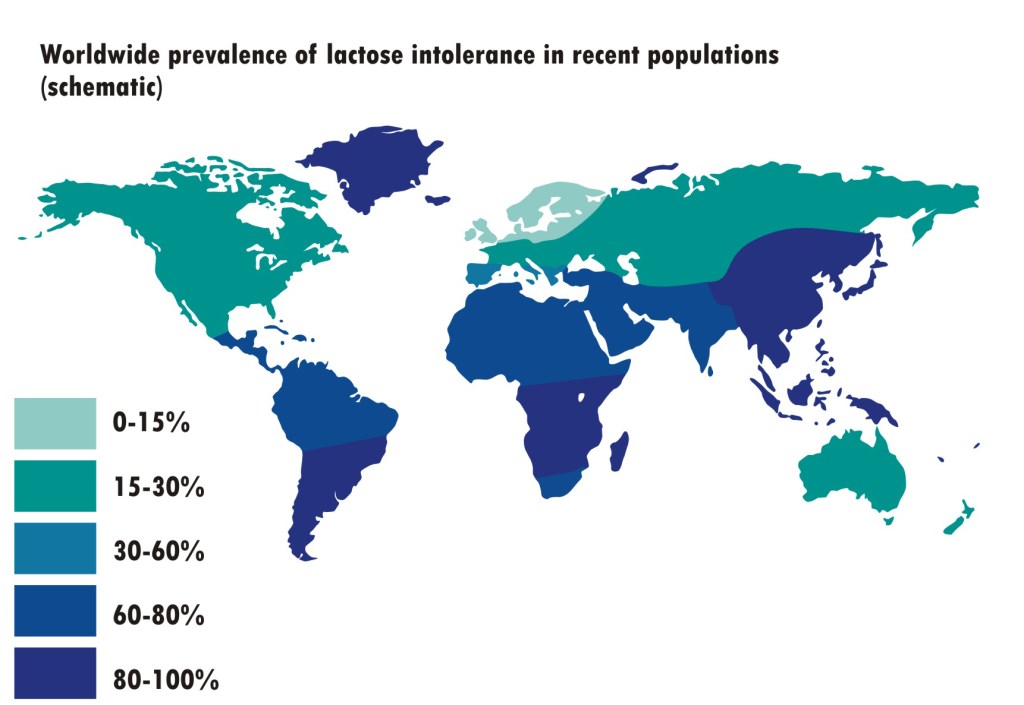
Far from an odd modern curiosity, milk has been associated with white supremacy in the United States for at least 100 years. In the 1920s, the National Dairy Council wrote, “the people who have achieved, who have become large, strong, vigorous people…who are progressive in science and every activity of the human intellect are the people who have used liberal amounts of milk and its products.” In the 1930s, History of Agriculture of the State of New York stated, “of all races, the Aryans seem to have been the heaviest drinkers of milk and the greatest users of butter and cheese, a fact that may in part account for the quick and high development of this division of human beings.” More recently, in 2015, The Economist published an article that echoed this racism, arguing that consuming milk helped Europe conquer the world. This dietary racism is codified in the Farm Bill, which places a heavy emphasis on dairy products in the WIC program and creates barriers to milk alternatives, even though people of color experience higher rates of food insecurity and are more likely to be lactose intolerant.
Around the time #milktwitter emerged, so did a new insult: soy boy. Some white supremacists posit that the high levels of phytoestrogens in soy reduce testosterone and sperm count. They believe there is a left-wing conspiracy to “create an army of soy boys from birth” through the use of soy baby formulas. While there is not a scientific consensus over the effects of soy on health, the rampant misogyny in white supremacist circles has seized on its connection to estrogen as a threat to the robust Aryan body, and thus it has become a way to insult the masculinity of leftists or anti-fascists. Soy’s popularity in East Asia, among populations that are frequently lactose intolerant, has led to the repackaging of the colonial derision of the “effeminate rice eater” in the 19th century.
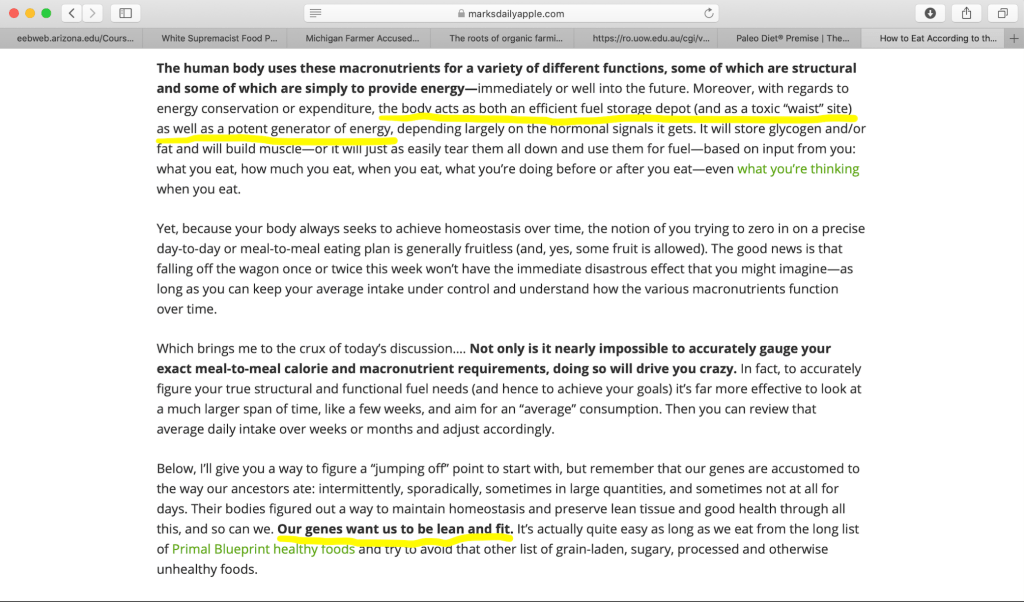
In other circles where racists proliferate, like CrossFit, this disparagement of a plant-based diet plays out in the popularity of paleo-type diets that emphasize the consumption of meat and “right” plants. While not overtly white supremacist, we can look at copy from Mark’s Daily Apple and see a preoccupation with genetics and the productivity of the body that is uncomfortably close to it:
To Eat and To Be For Angeli and other white supremacists, their concerns about food seem to turn an old adage on its head: you eat what you are. What they desire to be is pure and separate, and their thoughts about appropriate diet reflect that. While this is the food ecology that Angeli’s dietary hangups emerge from, it’s important to note that it’s a milieu most of us swim in without noticing. Especially in January, a large portion of media and thus psychological space is preoccupied with weight loss, wellness, and clean eating, and that messaging is often subtly reinforcing white supremacy. When you, especially if you are a white person, do a Whole30 challenge or a juice cleanse, you may assert that you are doing it for health. I ask you to stop and consider: what do you believe is healthy, and why do you believe that? Who are the people giving you this information? What type of body are you trying to create, and why do you want to change?
 the main character of every grocery store
Leave a comment