My sister is going through boxes of photos and papers and notebooks that my mother wanted to get rid of but did not want to be directly responsible for throwing away. Usually I end up with baby photos of relatives I barely speak to or photos of myself as a teenager that make me realize that someone should really have told me I was pretty, and someday I’ll make someone else throw all that away. But this week’s find was a little more Precious Moments on the surface because she came across recipes handwritten by our Granny Abby.
Casey tends to send me photos of things so I can decide whether I want them, and the first one she sent me was a recipe for Old Time Apple Cake. A few things:
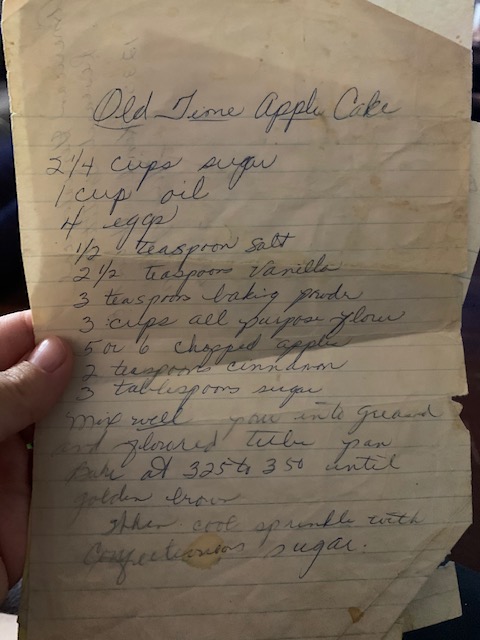
- We’re hill folk. We grew up near Boone, NC, and Granny grew up in West Virginia. Apple cake is pretty common across the mountains, although a lot of folks may be more familiar with apple stack cake and the dubious folklore of wedding guests each bringing a layer of cake to contribute.
- “Old Time” screams to me that this recipe might be lifted from a church cookbook and meant for revival or homecoming. But it also leaves me wondering what “Old Time” would have meant to Granny and how far back the roots of this recipe go, particularly since she was a notorious liar about many things and no one knew her exact age. The courthouse that held her birth certificate burned down, and Great-Granny Flossie claimed to have forgotten the year of Granny Abby’s birth.1
- Granny was not one of those grannies whose biscuits you dream about but can never replicate. I was seven when she died, so I don’t remember much about her other than the chain smoking that finally took her out. I asked Mom if she baked or cooked and she said, “She did, but not great and not willingly.” I did not expect to ever get a family recipe handed down from a dusty box, least of all from this woman.2
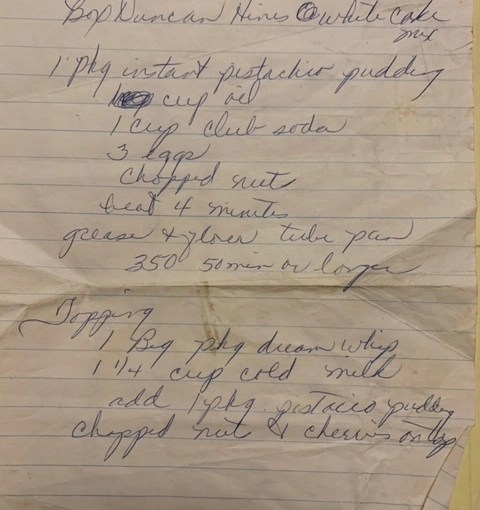
It was the second recipe that whispered, yes, child, this is your history: Don’t bother with a brand name or any kind of helpful guidance! Literally just toss a couple of boxes of powder and some soda in there.
It’s also this second recipe that got me thinking about the dusty boxes that someday my grandchildren might sift through. Although she wasn’t much in the kitchen, Granny did come from an era where people had more cooking knowledge. Whereas I had to learn in what order and how to mix ingredients for a cake through baking blogs and working at a cafe, she would have learned that at home from her mother or grandmother.
Millennials (and Zoomers too) have tended towards “cognitive offloading” when it comes to home economics tasks like cooking, relying on the internet for basic instructions. Even though I get creative sometimes in the kitchen, I hardly ever write recipes down. If they are written, they’re online in emails or Google Docs that, given the nature of digital media, could become inaccessible or simply disappear. Whether it’s through a loss of cooking knowledge, changing availability of ingredients due to climate change or other causes, or gaps in documentation or language, those who come after me might not even understand where to begin if they want to cook like Granny.
Take, for example, recipes from the Yale Babylonian Collection. In 2019, scholars attempted to reproduce dishes that were first prepared almost four thousand years ago and were recorded on cuneiform tablets. One such recipe for a vegetarian stew known as Unwinding reads thus:
I’m a mediocre cook. I’m not a scholar immersed in re-creating historical food. So when I first read this recipe my thoughts were:
- How do I prepare the water? Am I boiling it? What kind of pot or pan is it in?
- What kind of fat am I adding? Is it animal fat even though they say meat is not used? Is it an oil? What kind of oil would they have had at the time – olive, maybe?
- What’s kurrat?
- Do I just chop up these ingredients like I would for a soup now?
- By dried sourdough, do they mean sourdough bread? Or something like a dried up starter?
And so on. While some basics of food preparation and the range of what’s acceptable to human tastes might remain the same, there’s a giant gap between what these people knew and what I know about food. There’s also a giant gap in what foods are available. Colonialism and environmental destruction have changed the landscape of foods dramatically over the course of hundreds of years.
Right now, we’re going through another era of incredible change. Stuck inside with COVID-19, a lot of us are cooking more and learning to stock a pantry rather than shop daily for our food needs. The economic depression we’re in threatens to end restaurants and food businesses that have been part of our culture for decades. Climate change may cause the extinction of many plants and animals we rely on for food. And, as mentioned before, we’re hardly writing any of this down in a durable material way. So, what happens if I keep these recipes from Granny in a box and somehow they survive to the beginning of the next century? I think the apple cake one might be “old time” enough in tradition to survive. But here’s what my grandkids might get confused by in the other recipe:
Ingredients
| Box Duncan Hines white cake mix | Duncan Hines is a Conagra brand, which seems too big to fail, so a record of what this is might at least survive. But considering it’s full of white flour and sugar, consumers making different dietary choices might drive it into extinction and it’d be impossible to find on a shelf in whatever their version of a supermarket looks like. |
| 1 pkg instant pistachio pudding | Pistachios are threatened by drought and heat brought by climate change, but a lot of these are based on artificial flavors. Pudding mixes, like cake mixes, seem to be a holdover from another culinary era and might also be difficult to find. |
| 1 cup oil | What kind? Canola, olive, coconut? |
| 1 cup club soda | It took me some googling to figure out the difference between club soda and other carbonated waters, so I imagine this might also be an unfamiliar ingredient. Also, are we still avoiding the metric system? |
| 3 eggs | Eggs seem pretty simple. But who knows? Maybe a new substitute comes from a lab? Maybe it’s not chicken eggs that are common but duck eggs? |
| Chopped nuts | What kind? How to chop them? |
Directions
| Beat 4 minutes | Is beat still used as a term for mixing? Do they know how to beat eggs? |
| Grease and flour tube pan | What to use to grease and flour the pan? It wasn’t mentioned above. What’s a tube pan? |
| [Bake at] 350 [degrees] 50 min or longer | I already had to clarify the shorthand used here, so would they be able to fill in the blanks? Are ovens the same? How to know when it’s done? |
Topping
| 1 Big pkg dream whip | I had to look up what Dream Whip is. It’s already hard to find in stores. What’s the size of the big package? |
| 1 ¼ cup cold milk | Same issue as the eggs – there’s potential milk substitutes in the future. Also still using Imperial measurements? |
| Add 1 pkg pistachio pudding | Is this the same package mentioned before or do I need to buy another? What am I adding it to? |
| Chopped nuts and cherries on top | The cherries came out of nowhere. This is a disaster. |
Good luck, kids. Granny needs a cigarette.
 the main character of every grocery store
Leave a comment